Havgard: Child of No Shore
Published August 20, 2026
How a nameless troll-child, turned away three times, walked north until the mountains fell into the sea, and earned the name Havgard, he who guards the sea.
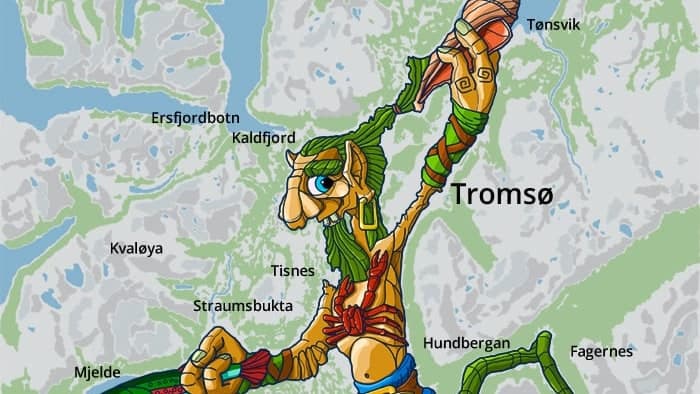
Once upon a time, though no one can say quite when, for troll-time is not counted the way ours is, a storm broke out over the outer skerries of the far north, the kind old sailors still cross themselves to remember. It was not an ordinary storm. Some say the sea itself was angry that night, as if something beneath the waves could not bear to share its waters with anyone at all.
When the storm passed, the fishermen who dared go out found no wreck and no bodies. They found only, tangled in a raft of storm-torn kelp and driftwood, a troll-child no bigger than a seal pup, fast asleep, with sand and small white shells caught in his hair.
No one came looking for him. Not that night, not the next, not ever.
Now, when a troll is born the proper way, his mother and father wait and watch to see what kind of troll he will grow into: a bergtroll of the mountains, a skogtroll of the deep woods, an elvetroll of the rushing rivers, and only then do they give him his name, for a troll's name is not just a word. It is a promise about who he is. But this troll-child had no mother and no father to wait and watch for him, and no one to make him any promises at all. And so he had no name. And being nameless, he did not know what kind of troll he was, either.
He grew slowly and strangely, for a troll grows fastest on the love of his own kind, and he had none to grow on.
Three homes he tried, in the years that followed, as is only right in stories such as this one.
First he went up into the mountains, for he was, after all, a troll and trolls belong in the mountains. But the bergtrolls sniffed at him and drew back. "You do not smell of stone and iron," they said. "You smell of salt and storm. You are none of ours." And they sent him away.
Then he went down into the forest, thinking perhaps he was a skogtroll after all. But the forest trolls only shook their mossy heads. "Look how the salt has dried white on your skin," they said. "A forest troll roots himself in soil, and you cannot even stand still." And they, too, sent him away.
Last he went to the river and begged the elvetrolls under their bridge to take him in. But they only laughed, not unkindly. "You do not wait for the water to come to you, little one, you go looking for it, out where the river forgets its banks and gives itself to the sea. That is not the river's way." And so they sent him away as well, as the old stories say it must happen three times before anything true can begin.
After the third turning away, the troll-child walked without knowing where, along the coast, for the coast was the only place that had never once told him to leave.
By day, three cormorants circled low over his head, screeching and diving and screeching again, and though he did not yet understand their tongue, something in him understood their direction, and he followed it. By night, far above the water, a rippling green light unrolled itself across the sky and seemed, more than once, to slow down and wait for him, the way you wait for someone you don't want to lose in the dark.
Between the birds by day and the light by night, the troll-child walked north and further north, until the mountains around him did something he had never seen a mountain do before: they stopped pretending to be separate from the sea, and simply fell into it, cliff after cliff, fjord after fjord, as if the land itself could not decide where it ended and the water began.
And the troll-child, who was not quite a bergtroll and not quite a skogtroll and not quite an elvetroll, and had never been able to decide what he was either, felt something in his chest go quiet for the first time in his life.
"Here," he said to no one, "no one has to choose."
That night the sea did what it does best: it grew angry without warning. A boat of fishermen, caught out past the last skerry, could not find their way home through breakers taller than their mast. The troll-child heard them the way you hear something in your own blood before you hear it with your ears, and without stopping to wonder whether it was his place to help, he swam out into the black water and set his own broad back against the worst of the waves until the boat slid, half-swamped but whole, into the calm of the sound.
An old crab, who had watched the whole thing from a bed of kelp on the bottom, was so struck by what he'd seen that he crawled all the way up onto the wet rocks to say so.
"I've lived on this seabed longer than most anything with legs," the crab said, "and I've never once seen a nameless thing behave so much like it already knew exactly what it was. You watch over the sea the way a father watches over a cradle. That should be your name, if no one has given you a better one: Havgard, he who guards the sea."
And the troll who had never had anyone to name him wept, for the first time not from loneliness, but from the opposite of it.
He never did learn who his parents were, or why the storm had taken them and left only him behind. But he did learn, in time, that the truth had not been lost. It had only been hidden, folded away and kept, the way the deepest currents keep whatever falls into them, by the one power in the north whose reach touched every skerry and every silence: a sea witch who allowed no water, and no memory that lived in it, to belong to anyone but herself.
Havgard came to understand, without anyone quite telling him so, the shape of the bargain the sea itself seemed to have made with him from the very start. He would guard her creatures and keep her waters safe, and ask for nothing in return, except that on the day he was strong enough, the sea would finally let him hear the one story that had always been kept from him: his own beginning.
He kept mostly to the water after that: trolls who live too long on land, even half-trolls of the sea, are not safe from the sun, and it is said he never once turned to stone, not even in the brightest summer, for the sea itself keeps that from happening to her own. But when a storm rises over the sound at Tromsø, and the weather turns too wild even for him to stay under, those who know where to look say they have seen a shape moving along one particular stretch of shoreline that is neither wave, nor rock, nor man.
There, and only there, Havgard still comes ashore. And there, they say, he is still waiting for the day he is ready to face the one power who alone can tell him who he was, before the storm made him into who he is now.