E9Huldrefjord
Pesta
In 1346, a tense and unstable Europe faces a new kind of enemy: not a foreign army or invading horde that can be fought off with weapons or a political crisis that can be resolved with an unhappy marriage, but an invisible threat that no one knows how to stop. It will take millions of lives and permanently change the course of history.
This is the story of the Black Death…
≈ 10 min read
Listen · 0:25
AI voice
Our audio guide is being renewed. While we update the exhibition, the new recordings are read by an AI voice in English and Norwegian. They will later be recorded by real voices in more languages. Thank you for your patience!
Did you know?
- The 14th century Black Death was the second of three plague pandemics. The first affected the Mediterranean and the Near East; it consisted of 18 waves starting in 541 CE with the Plague of Justinian and ending in 767. The third lasted from 1855 until 1960 and was mostly contained to Asia.
- Norwegian surnames like Ødegaard/Ødegård, Audnedal, Ulland and toponyms like Øyjord, Bakkerud, Nygård come from the time of the Black Death and relate to abandoned, then reclaimed parts of land.
The Black Death in Europe
3 minThe Black Death was a devastating plague pandemic that spread across Europe, the Middle East, and North Africa between 1346 and 1353. It killed an estimated 30-60% of Europe’s population. The massive loss of life reshaped societies, weakening existing power structures and changing how people lived and worked.
The Black Death in Norway
3 minThe Black Death reached Norway in 1349, likely arriving by ship in the city of Bergen. By the middle of 1350 the worst of the epidemic had passed, but the plague is estimated to have killed around 60 percent of the population, making Norway one of the hardest-hit regions in Europe. The resulting demographic shock weakened Norwegian society and institutions and contributed to the country’s eventual loss of independence to Denmark.
Pesta
3 min
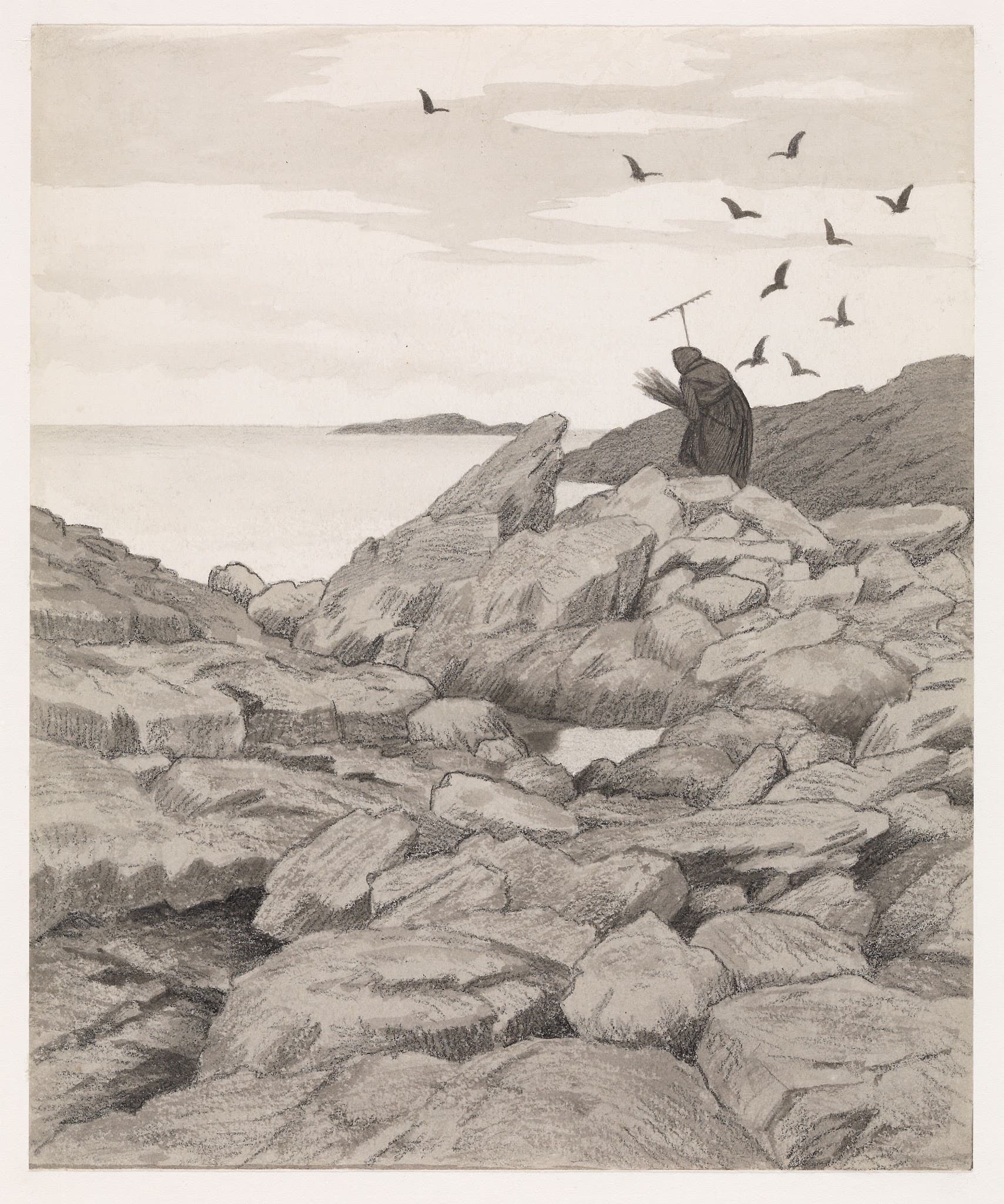
Published in 1900, The Black Death is one of Theodor Kittelsen’s most famous works. It combines 15 poems with 45 illustrations inspired by legends about the plague in Norway. The disease appears as Pesta, an old woman who travels the land with a rake and a broom: where she sweeps, all die; where she rakes, some survive.
In 1894, Theodor Kittelsen becomes fascinated with the history and legend of the Black Death. It’s grim, macabre, eerie: exactly the atmosphere he enjoys creating in his art. Historical documentation is plentiful in the annals of visiting Icelandic clergymen, but it is primarily the ample surrounding mythology that inspires him.
Supposedly, the ship that brought the plague to Norway arrived with no crew: a ghost ship that local dock workers had to rescue so as not to let the grain it was carrying go to waste. Allegedly, in some remote villages, the only survivors were the children who ran away to the forests nearby. They survived on berries for months until they were found by hunters looking for grouse, emaciated and afraid and near-feral from the ordeal. Apparently, a family in small village somewhere in South Norway was willing to burn their own house with their children inside to ward off the plague.
The more Theodor learns of these stories, the more an image of Pesta, pestilence personified, crystallizes in his head. He pictures her just like the legends describe: as an old woman, short and ugly, with gray-yellow-green skin and sunken eyes, dressed in dark rags, a ghoulish figure that travels across the land and leaves death in her wake.
For two years, Pesta preoccupies his mind. He draws her as an ominous stranger in the familiar landscapes of Western and Northern Norway. She carries a broom and a rake; where she sweeps with the broom, everyone dies and where she uses the rake, some survive. He writes about her, too, stories and verses in a style inspired by medieval writings and Andreas Faye. The words make it clear that she does not care about who she runs into on her journey: the young and the old, the rich and the poor, the kind and the unkind, none are spared. So cruel is she that in the stories even trolls take pity on her victims and help the orphans she leaves behind.
When all is said and done, Theodor is left with 15 poems and short stories and 45 illustrations. He will publish them under the title The Black Death in 1900. It will become one of his most famous works, considered to be a pinnacle of his career.